
Day 9: What is a system?
Let's go back a step. Maybe we should have started here!

(This is part of the “30 Systems ‘Tools’ in 30 Days” series. Visit here for the intro to the series.)
I know we are all the way at Day 9 of this series on “systems tools,” but I only just realized that I never even answered a key question: What even is a system?
I am being a bit lazy today, so instead of writing this up from scratch, I am going to give you the definition we used in The 55 Minutes, a book Anna Johnson and I co-authored with James Stauch.
(The rest of this piece, until the video, is from The 55 Minutes)
We’ve all heard some version of the saying “The whole is greater than the sum of its parts.” This well-known aphorism misquotes the philosopher Aristotle. What Aristotle really said, nearly twenty-four hundred years ago in his book Metaphysics, was “. . . the totality is not, as it were, a mere heap, but the whole is something besides the parts.”1 [The image above] illustrates the essence of a system. It is not “a mere heap,” a collection of random parts, but rather is something other than simply the parts that make it up.
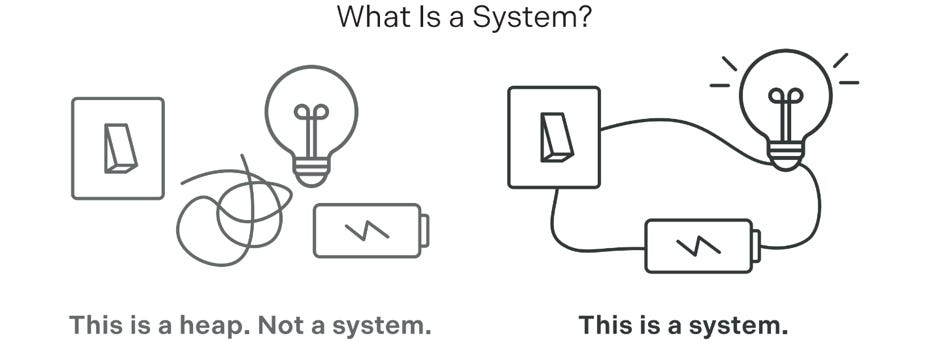
Let’s look in a bit more detail at what a system is composed of. At its most basic level, even the simplest of systems require three things:2
Elements (nodes): These are the parts, the building blocks. They are the nouns in the system. Think of apples on a tree, players on a sports team, or start-up companies in a new industry.
Interconnections (interactions): These define how the elements connect or relate to each other, like the strings that tie everything together.3 It can be a bond (from a chemical bond to a bond of friendship), a transactional connection, or a much more varied or nuanced kind of connection. In business, think of an investment or funding relationship, a client service relationship, or a supply chain.
Function or purpose (emergent properties): This is what the system is doing, the big-picture outcome it produces, whether intentionally designed or unintentionally emergent. No single organ in your body is responsible for keeping you alive, but together, that is what the whole system is working toward: keeping you alive and functioning. This distinct function disappears if parts of the system are separated from each other. The parts do not themselves contain the emergent property of the system. They go back to being a heap, or maybe they connect in some other way to produce a new or different system.
To summarize, a system is simply anything that has multiple components—call them parts, nodes, elements (which can be people, places, or things)—that connect or interact in some way and that produce “emergent” results, something new that has properties different than what any of the parts could achieve on their own.4 A liquid is only a liquid when atoms or molecules interact with each other in a certain way. Each molecule itself (like a molecule of H20) is not capable of being a liquid on its own, so liquidity is an emergent property as is being a solid or a gas. Other emergent properties for chemical compounds or materials that don’t exist at the particle level include magnetism, viscosity, rigidity, malleability, acidity, and solubility.
This does not mean the individual parts of the system are meaningless or have no influence or agency. Again recalling Ackoff, a system is “a whole consisting of independent parts, each of which can affect the behavior of the system.”5 In simpler terms, a system isn’t just a heap of stuff thrown together. It’s the magic that happens when those things start working together in specific ways.
Think of an orchestra. Before the concert begins, we hear the sound of disorder: musicians warming up and instruments being tuned. But there is no structure, no overall function. It’s a “heap” of musicians and instruments—groomed and well dressed (or well polished) but still a heap. But once the conductor raises the baton, a system is underway. The elements forge interconnections: Even a small chamber ensemble of sixteen people and instruments has over sixty-five thousand potential connections, and each of those connections can resonate or harmonize or counterpoint or juxtapose differently, creating a nearly infinite number of possible permutations. The emergent result is the symphony or concerto. And the overall function is to please our ears or to challenge us or to evoke an emotional response.
And—unlike with a heap of parts—change definitely happens when you add, remove, or alter a part of the system. Depending on which part is altered, the alteration may profoundly change the system, or the change may barely be perceptible. But it will change. It may be harder to detect the removal of a viola or cello from the orchestra, versus the timpani or piano, but it will still change.
The concept of “emergence” is foundational to understanding human-made systems. Emergence is distinct from (and in many ways the inverse of) determinism. In determinism, the parts (and the rules governing the interaction of the parts) make the system utterly predictable. But with emergence, something new and often unexpected “emerges.” This could be as basic as the fractaling of snowflakes or swarm behavior in insects, birds, and fish. Or it could be as supererogatory as language, morality, or intelligence.
Take the example of a coin or banknote. These have no innate purchasing power outside of a complex set of human institutions and social contracts. The coin or banknote is just a disc of metal or a sheet of paper (or in some countries, like Egypt, Vietnam, and Canada, plastic polymer). You can’t eat it, build a house with it, or save a life with it. It’s only when the banal material of a coin or banknote becomes part of a system with interconnections and interactions that it acquires symbolic meaning and social significance. Exchange value—and, in turn, market transactions, commercial trade, and finance—are all emergent properties of currency. The invisible hand of the market is an emergent property. So is prosperity. Even life itself is an emergent property. We exist because of emergence, but we also must endure emergent things that bring misery, from groupthink to recessions, from rioting and looting to war.
By now, you can likely appreciate that systems are everywhere. In fact, nothing would make sense without systems. Systems are essential to understanding reality. We are surrounded and shaped by systems of both natural and human design, from any living cell or organism to machines and electricity grids to entire galaxies. Systems can be manufactured—computers, cars, and transportation networks are systems. Systems can also be social in nature—from games, sports, music, and theatrical performances to financial, educational, health care, and political systems. And systems connect to, are part of, and in turn contain other systems. Consider, for example, that the Milky Way Galaxy is a necessary component of the dung beetle’s primary system: The beetle can only roll its payload in a straight line away from the pile when it can navigate by the Milky Way on cloudless, moonless nights.
The Video
Me, my kids’ keyboard, and a key question: What is a system?!?!?
Prompts
What systems do you work in, or care about?
What are the elements? What are the interconnections? And what is the purpose?
Does the perceived purpose from those who look at the system from the outside match with the actual purpose based on the system’s structure and results?
How might thinking about your work in the context of wider systems help you?
SE Scholar, “Who Said ‘The Whole Is Greater Than the Sum of the Parts’?” June 6, 2019, https://se-scholar.com/se-blog/2017/6/23/who-said-the-whole-is-greater-than-the-sum-of-the-parts.
These three components come from Meadows, a leading thinker in systems change, who defines a system as “an interconnected set of elements that is coherently organized in a way that achieves something” (Meadows, Thinking in Systems, 11).
We use “interconnections” throughout this book as shorthand, but it is meant to include any kind of interaction or relationship between the elements/nodes.
Meadows, the late MIT researcher who is widely considered to be one of the most important twentieth-century advocates for systems thinking, says that “[a] system is a set of things—people, cells, molecules, or whatever—interconnected in such a way that they produce their own pattern of behavior over time” (Meadows, Thinking in Systems, 2).
“Systems Thinking Speech by Dr. Russell Ackoff,” posted November 1, 2015, by Awal Street Journal, YouTube, 1 hr., 10 min., 57 sec,